 by
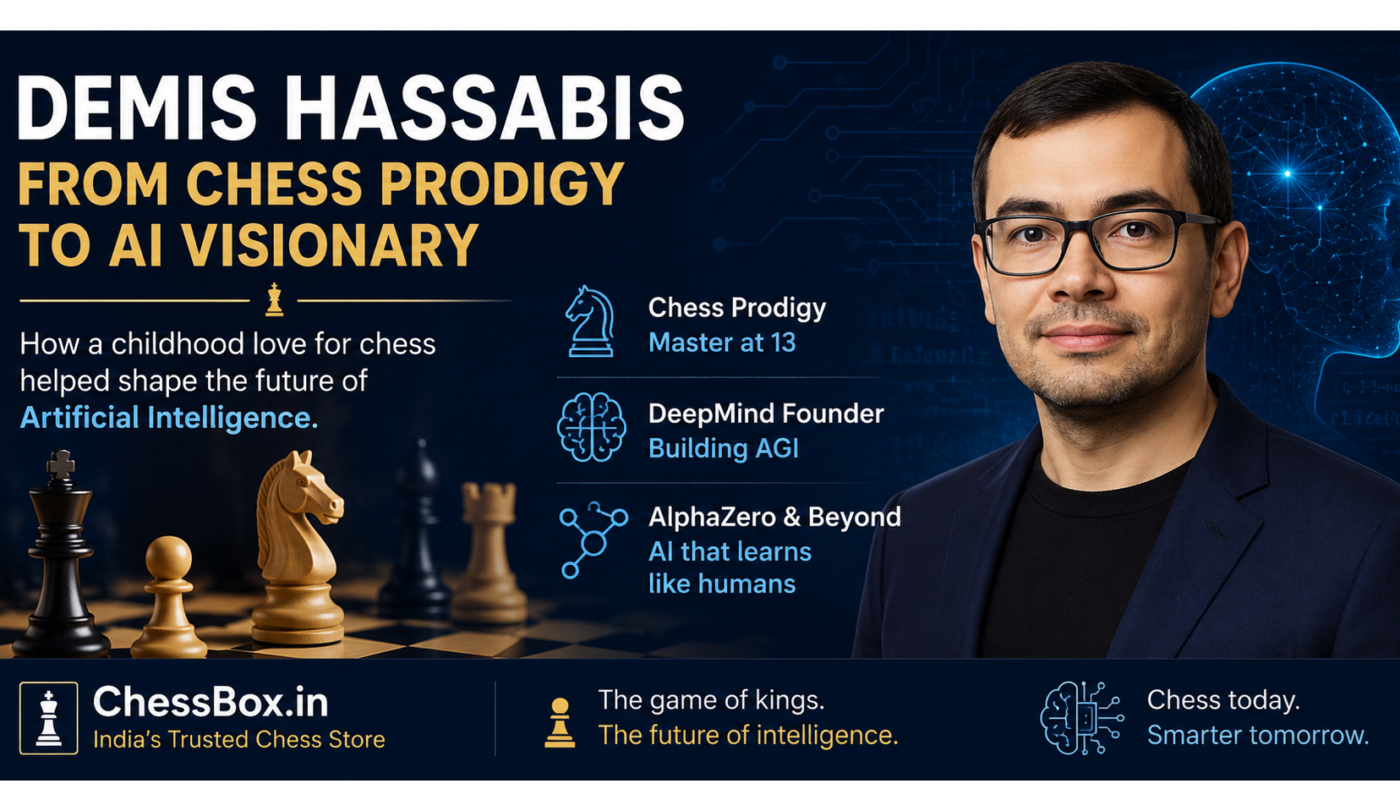
by How a Childhood Love for Chess Helped Shape the Future of Artificial Intelligence
By ChessBox.in – India’s Leading Chess Set Provider
Few people have transformed both the world of chess and the field of artificial intelligence as profoundly as Sir Demis Hassabis. While millions know him as the co-founder and CEO of Google DeepMind, fewer realize that his extraordinary journey began not in a research laboratory, but over a chessboard.
Long before DeepMind’s revolutionary breakthroughs with AlphaGo, AlphaZero, and Gemini, Hassabis was a gifted child fascinated by one of humanity’s oldest strategy games. The lessons he learned from chess would later influence how machines learn, think, and solve problems.
This is the remarkable story of how chess became the foundation for one of the greatest AI revolutions of our time.
A Chess Prodigy from Childhood
Born in London in 1976, Demis Hassabis discovered chess at the age of four after watching his father play.
His talent became apparent almost immediately.
Within just a few years, he was competing against players far older than himself. By the age of 13, Hassabis had achieved the title of Chess Master, making him one of the strongest junior players in the United Kingdom.
He represented England in several international youth competitions and consistently ranked among the country’s brightest chess talents.
Although many expected him to pursue professional chess, Hassabis had a broader vision.
He became fascinated not only with how humans play chess, but how humans think.
That question would define his life’s work.
Chess: The Perfect Laboratory for Intelligence
Chess has always been more than a board game.
It is a model of:
- Decision-making
- Pattern recognition
- Long-term planning
- Memory
- Creativity
- Risk management
- Strategic thinking
For Hassabis, chess demonstrated that intelligence is not merely about calculating moves—it is about understanding positions, learning from experience, and adapting to changing situations.
These same qualities would later become central to artificial intelligence research.
From Cambridge to Computer Games
Hassabis studied Computer Science at the University of Cambridge, where he graduated with top honors.
Instead of immediately entering academia, he joined the video game industry.
At just 17 years old, he worked at Bullfrog Productions, contributing to the development of the critically acclaimed strategy game Theme Park.
Game development deepened his understanding of:
- Simulation
- Decision systems
- Human behavior
- Complex environments
These experiences later proved invaluable in designing intelligent learning systems.
The Birth of DeepMind
In 2010, Demis Hassabis co-founded DeepMind with Shane Legg and Mustafa Suleyman.
Their ambitious goal was unlike anything attempted before:
Build artificial general intelligence capable of solving complex problems by learning, rather than relying solely on handcrafted rules.
This philosophy echoed chess.
Great chess players are not simply taught every possible move—they learn patterns, improve through experience, and develop intuition.
DeepMind sought to teach machines in much the same way.
Chess Returns: AlphaZero Changes Everything
Although IBM’s Deep Blue defeated Garry Kasparov in 1997 through massive search and handcrafted evaluation, DeepMind took a radically different approach.
Instead of programming chess knowledge into the system, they created AlphaZero.
AlphaZero learned chess from scratch.
It received only:
- The rules
- The objective of checkmate
No opening books.
No grandmaster games.
No human strategy.
It simply played against itself millions of times.
Within hours, AlphaZero surpassed the world’s strongest chess engines.
Why AlphaZero Was Revolutionary
Traditional engines relied on:
- Extensive opening databases
- Carefully tuned evaluation functions
- Human-designed heuristics
AlphaZero relied on:
- Self-learning
- Neural networks
- Reinforcement learning
- Experience
Its style amazed the chess world.
Instead of merely calculating deeper, AlphaZero displayed concepts that appeared almost human:
- Long-term sacrifices
- Positional pressure
- Initiative over material
- King activity
- Dynamic compensation
Many grandmasters described its games as surprisingly beautiful.
Lessons Chess Taught AI
Pattern Recognition
Strong chess players instantly recognize familiar structures.
Modern AI systems do exactly the same.
Planning
Chess teaches players to think several moves ahead.
AI planning systems use similar principles when evaluating future outcomes.
Learning Through Experience
Every chess game teaches something new.
AlphaZero improved exactly the same way.
Balancing Risk and Reward
Should you sacrifice a pawn for activity?
Should you exchange queens?
Chess constantly asks these questions.
AI systems now evaluate similar trade-offs in:
- Robotics
- Medicine
- Finance
- Logistics
Beyond Chess
The techniques developed through AlphaZero extended far beyond board games.
DeepMind later applied similar learning systems to:
Protein Folding
AlphaFold solved one of biology’s greatest challenges by accurately predicting protein structures.
Scientists consider it one of the most important breakthroughs in modern biology.
Healthcare
AI systems now assist researchers in:
- Drug discovery
- Medical imaging
- Disease prediction
Climate Research
Machine learning models optimize:
- Energy usage
- Weather prediction
- Resource allocation
Chess as a Training Ground for Intelligence
Many researchers believe chess remains one of the best environments for studying intelligence.
Why?
Because chess combines:
- Perfect information
- Infinite creativity
- Complex planning
- Adaptation
- Learning
The same characteristics appear in real-world decision-making.
For Hassabis, chess became a miniature version of intelligence itself.
What Chess Players Can Learn from Demis Hassabis
Curiosity Matters
Hassabis wasn’t satisfied with becoming a strong player.
He wanted to understand why intelligence works.
Think Beyond Results
Winning games is rewarding.
Understanding your thinking process is even more valuable.
Learn Continuously
AlphaZero never stopped learning.
Neither should we.
Embrace Creativity
Many of AlphaZero’s best moves surprised grandmasters.
Innovation often begins where conventional thinking ends.
The Human Side of AI
Despite leading one of the world’s most advanced AI companies, Hassabis frequently emphasizes that AI should complement human intelligence rather than replace it.
Chess illustrates this perfectly.
Today’s strongest players train with engines every day.
Rather than diminishing human creativity, AI has elevated the overall standard of chess, helping players discover new ideas, refine strategies, and explore positions more deeply than ever before.
Demis Hassabis’ Legacy
Demis Hassabis has achieved something extraordinary.
He connected a childhood passion with one of humanity’s most ambitious scientific endeavors.
The strategic lessons he learned as a young chess player helped shape technologies that are transforming medicine, science, education, and countless other fields.
His journey demonstrates that the skills developed over a chessboard—critical thinking, patience, creativity, and problem-solving—can extend far beyond the game itself.
Final Thoughts
The story of Demis Hassabis is more than a tale of chess or artificial intelligence. It is a reminder that curiosity, disciplined learning, and strategic thinking can open doors to groundbreaking innovation.
From a talented young chess master in England to the founder of one of the world’s leading AI research organizations, Hassabis has shown that the principles of chess are deeply connected to the future of intelligent machines.
For every young player studying openings, solving puzzles, or dreaming of becoming a grandmaster, his journey offers an inspiring message: the lessons learned on 64 squares may one day help solve challenges far beyond the chessboard.
At ChessBox.in, we celebrate not only the champions of chess but also the visionaries who demonstrate how the game can shape lives, careers, and the future of technology.