
 by
by By ChessBox.in | World Chess Championship Preview | November–December 2026
The chess world is preparing for a historic encounter as reigning World Champion D. Gukesh of India gets ready to defend his title against Uzbekistan’s rising star, Javokhir Sindarov. The 2026 FIDE World Chess Championship promises to be one of the most compelling title matches in modern chess, bringing together two exceptionally talented players from a generation that is rapidly reshaping the competitive landscape.
Both grandmasters will be just 20 years old when the match begins, making this the youngest World Championship contest in history. More than a battle for the most prestigious title in classical chess, this encounter represents a changing of the guard, with two young talents seeking to establish their place among the game’s all-time greats.
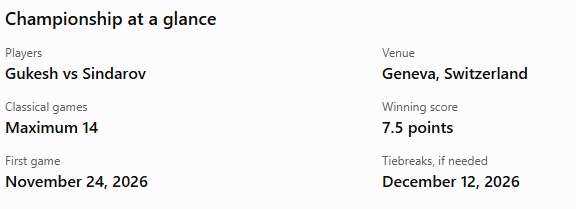
The match will take place in Geneva, Switzerland, from November 22 to December 12, 2026, at the Fondation Martin Bodmer. It will feature up to 14 classical games, with the first player to reach 7.5 points crowned World Champion.
1. Geneva 2026: A Historic World Championship Venue
Geneva will provide a distinguished setting for this historic encounter. The city, known for its international institutions, diplomacy and cultural heritage, was selected after interest from several potential host countries, including India, the United States and Cyprus.
The match will bring the World Championship back to Switzerland for the first time since the 2004 contest in Brissago, where Vladimir Kramnik successfully defended his title against Peter Leko.
The Fondation Martin Bodmer, a renowned institution dedicated to preserving literary and cultural heritage, offers a fitting backdrop for a contest built around intellectual discipline, preparation and strategic creativity.
The official programme begins on November 22 with Media Day and the opening ceremony. The first classical game is scheduled for November 24, with the final scheduled game on December 11 and tiebreaks, if required, on December 12.
International Chess Federation
+1
2. D. Gukesh: The Youngest Undisputed World Champion
India | World Champion
D. Gukesh
Gukesh made history in December 2024 by defeating Ding Liren in Singapore to become the youngest undisputed World Champion at just 18 years old. His victory in the final, 14th classical game secured a 7.5–6.5 match score and established him as one of the defining talents of his generation.
Gukesh’s playing style is characterized by extraordinary calculation, ambitious decision-making and a willingness to embrace complex positions. His strength lies in his ability to identify dynamic opportunities and maintain pressure even in positions that appear balanced.
His victory in the 2024 Candidates Tournament demonstrated his ability to perform under immense pressure. He followed that achievement with a world title and impressive performances at team events, including the 2024 Chess Olympiad, where India won gold.
Gukesh’s key strengths
- Deep calculation: He is capable of navigating complicated tactical positions and calculating forcing variations with remarkable accuracy.
- Fearless approach: Gukesh is comfortable taking calculated risks, particularly when he senses an opportunity to seize the initiative.
- Opening preparation: His preparation allows him to enter complex middlegames with clear strategic objectives.
- Competitive resilience: His rise to the world title reflects his ability to recover from difficult moments and maintain focus over long tournaments.
His principal challenge will be to balance his natural ambition with the patience required in a long World Championship match. Against a challenger as well-prepared as Sindarov, overpressing a balanced position could become costly.
3. Javokhir Sindarov: The Challenger Who Defied Expectations
Uzbekistan | World Championship Challenger
Javokhir Sindarov
Sindarov has emerged as one of the most exciting players in world chess. His victory in the 2025 FIDE World Cup in Goa and his dominant performance at the 2026 Candidates Tournament in Cyprus earned him the opportunity to challenge for the ultimate title. He won the Candidates unbeaten, scoring 10/14, and secured qualification with a round to spare.
Sindarov’s greatest strength is his combination of tactical sharpness, positional understanding and exceptional confidence. He is a dynamic player who can create practical problems for his opponents without necessarily taking excessive risks.
His performance in the Candidates Tournament demonstrated remarkable consistency. Winning a demanding 14-round double round-robin without a defeat is an outstanding achievement, particularly against a field of elite grandmasters.
Sindarov’s key strengths
- Tactical alertness: His ability to identify combinations and exploit small inaccuracies makes him dangerous in complicated positions.
- Practical decision-making: Sindarov is effective at creating positions in which his opponent must solve difficult problems over the board.
- Opening flexibility: His repertoire allows him to adapt to different opponents and strategic requirements.
- Mental resilience: His unbeaten Candidates performance highlights his composure and ability to maintain consistency under pressure.
Sindarov’s biggest opportunity will be to use his momentum and confidence to challenge Gukesh from the opening game. However, a World Championship match presents a different challenge from a tournament: the same opponent must be faced repeatedly, allowing both players to adapt their preparation and strategy.
The Match Format: 14 Games to Decide the World Champion
Classical time control
- 120 minutes for the first 40 moves
- 30 minutes for the remainder of the game
- 30-second increment per move from move 41A player reaching 7.5 points wins the match. If the score is 7–7 after 14 games, tiebreaks will decide the champion.
A player reaching 7.5 points wins the match. If the score is 7–7 after 14 games, tiebreaks will decide the champion.
The format rewards consistency, preparation and the ability to manage energy across several weeks. A 14-game match is long enough for players to adjust their strategies, but short enough that one or two decisive results can have a major impact on the final outcome.
An important feature of the regulations is the restriction on early draw offers. Players cannot offer a draw before Black’s 40th move. Before that point, a draw can be claimed through the Chief Arbiter or Deputy Chief Arbiter only in cases of threefold repetition or stalemate. This encourages players to explore competitive positions rather than agreeing to routine early draws.
International Chess Federation
If the classical portion finishes level, the tiebreak begins with four rapid games at 15 minutes plus a 10-second increment per move. The prospect of a rapid finish adds another dimension to the preparation of both players.
5. A Clash of Two Distinct Playing Philosophies
The match presents an intriguing contrast between two players who share exceptional calculation skills but have developed different competitive identities.
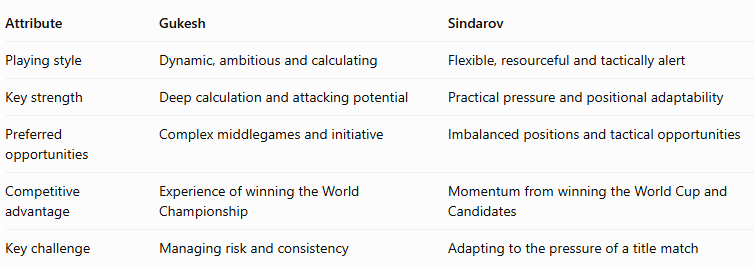
Gukesh’s experience in a World Championship match against Ding Liren could prove important. He has already experienced the psychological intensity of playing for the most prestigious title in chess.
Sindarov, meanwhile, brings the confidence of a challenger who has demonstrated exceptional form in knockout and round-robin competitions. His ability to remain unbeaten in the Candidates suggests that he can handle sustained pressure.
The most interesting question is whether Gukesh can impose his aggressive style or whether Sindarov can neutralize the champion’s initiative and turn the match into a battle of patience and precision.
6. The Opening Battle Could Define the Championship
At the highest level, opening preparation is not simply about remembering long theoretical variations. It is about understanding the resulting positions, identifying the opponent’s preferences and creating practical problems.
Gukesh is known for his extensive preparation and willingness to enter sharp theoretical battles. He may look for positions where his calculation and attacking instincts can create long-term pressure.
Sindarov is also a well-prepared player, and his flexibility could be a major asset. He may seek to vary his opening choices to prevent Gukesh from settling into a predictable preparation routine.
The critical areas to watch will include:
- Repertoire flexibility: Whether either player introduces unexpected openings or sidelines.
- Preparation depth: How effectively they handle their opponent’s novelties.
- Time management: Whether either player spends too much time resolving opening complications.
- Strategic transitions: How effectively they convert opening preparation into favorable middlegames.
In a match of this magnitude, even a small opening advantage can have a psychological impact, particularly if it forces the opponent to defend an uncomfortable position for several hours.
7. Psychological Strength and Match Management
World Championship matches are as much a test of mental strength as they are of chess ability. Unlike a regular tournament, where a player can recover from a defeat by focusing on the next opponent, a title match involves repeatedly confronting the same rival, who is constantly adapting.
Gukesh has already experienced the pressure of a World Championship final. His victory over Ding Liren in 2024 demonstrated his ability to remain competitive through a long match, even after difficult moments.
Sindarov’s challenge will be to maintain the confidence that brought him through the Candidates while adapting to the unique pressure of a World Championship. He will need to avoid becoming overly ambitious after a good result or excessively cautious after a setback.
The rest days, preparation sessions and support teams will be crucial. The ability to recover emotionally after a difficult game could be just as important as the ability to calculate a complicated variation.
8. The Significance of the Match for Indian and Uzbek Chess
The championship has significance far beyond the individual ambitions of the two players.
For India, Gukesh represents the continued rise of a generation that has transformed the country’s position in global chess. His title victory in 2024 was a historic achievement, and successfully defending the crown would further strengthen India’s standing as a leading chess nation.
For Uzbekistan, Sindarov’s qualification is another major milestone. Following the country’s growing success in international team and individual competitions, his challenge for the World Championship represents the arrival of another Uzbek star on the biggest stage.
The match also reflects a wider shift in elite chess. Young grandmasters are increasingly capable of challenging established champions, supported by advanced chess engines, online training resources, stronger coaching systems and increasingly competitive junior tournaments.
A victory for either player would provide a powerful inspiration for aspiring chess players in their respective countries and around the world.
9. Technology, AI and the Modern World Championship
Artificial intelligence has transformed the preparation of elite chess players. Modern engines can analyse positions with extraordinary precision, identify hidden tactical resources and reveal strategic ideas that were once difficult for human players to discover.
Both Gukesh and Sindarov belong to a generation that has grown up with powerful chess engines and sophisticated preparation methods. Their teams will likely spend considerable time analysing opening novelties, evaluating critical middlegame positions and identifying practical opportunities in endgames.
However, engine preparation is only one part of the equation. The real test comes when a player encounters an unfamiliar position over the board and must make a decision independently.
The ability to understand engine recommendations, remember critical variations and apply them under match pressure will be essential.
The championship is therefore also an opportunity to observe how modern grandmasters combine human intuition with machine-assisted preparation.
10. Who Has the Advantage? Our Expert Prediction
Predicting a World Championship winner is always challenging, particularly when both contenders are young, ambitious and exceptionally talented.
Why Gukesh could win
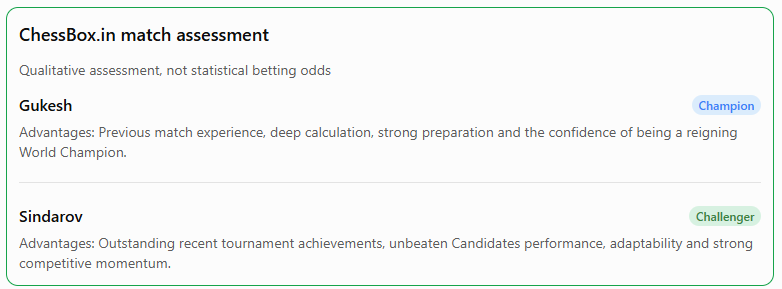
Gukesh has already demonstrated that he can perform under the enormous pressure of a World Championship match. His ability to calculate deeply and create winning chances from complex positions could be decisive, particularly if he manages to combine his attacking instincts with patience.
His experience of preparing for and playing a title match is a significant advantage, especially when dealing with the emotional demands of a long contest.
Why Sindarov could win
Sindarov arrives with tremendous momentum after winning the 2025 World Cup and the 2026 Candidates Tournament. His confidence, tactical awareness and ability to maintain consistency against elite opponents make him a formidable challenger.
If he can neutralize Gukesh’s attacking potential and exploit moments of overambition, he has every chance of taking control of the match.
Our prediction
This is a particularly difficult match to call. Gukesh’s experience as World Champion gives him a valuable advantage, while Sindarov’s recent results make him an exceptionally dangerous challenger. The opening games could prove decisive in determining the psychological direction of the contest.
Our expectation is a closely fought match with several decisive games, although a result cannot be confidently predicted from tournament form alone. The player who manages risk, time and psychological pressure most effectively will have the strongest chance of lifting the trophy.
11. The Global Spotlight and Commercial Significance
The 2026 World Championship is also an important event for the global chess industry. The match has attracted major commercial interest, with Salesforce as a title sponsor and Freedom Holding Corp. as general partner. FIDE has also emphasized the importance of technology and global partnerships in expanding the reach of major chess events.
International Chess Federation
+1
The Geneva venue, international media attention and online coverage offer an opportunity to reach audiences beyond traditional chess enthusiasts.
For the chess community, this visibility can encourage greater participation in schools, academies and clubs. It can also create new opportunities for chess education, coaching, tournament organization and equipment providers.
The championship is not just a contest for the title; it is a major showcase for the continued growth and commercial development of chess worldwide.
12. Key Dates to Remember
- November 22, 2026 Opening ceremony and Media Day in Geneva.
- November 24, 2026 First classical game of the World Championship match.
- November 24 – December 11, 2026 Scheduled period for the 14 classical games.
- December 12, 2026 Tiebreaks, if required, followed by the conclusion of the match.
| Date | Event |
|---|---|
| Sunday, 22 November | Media day and opening ceremony |
| Monday, 23 November | Media day and technical meeting |
| Tuesday, 24 November | Game 1 |
| Wednesday, 25 November | Game 2 |
| Thursday, 26 November | Game 3 |
| Friday, 27 November | Rest day |
| Saturday, 28 November | Game 4 |
| Sunday, 29 November | Game 5 |
| Monday, 30 | Game 6 |
| Tuesday, 1 December | Rest day |
| Wednesday, 2 December | Game 7 |
| Thursday, 3 December | Game 8 |
| Friday, 4 December | Game 9 (If required) |
| Saturday, 5 December | Rest day |
| Sunday, 6 December | Game 10 (If required) |
| Monday, 7 December | Game 11 (If required) |
| Tuesday, 8 December | Game 12 (If required) |
| Wednesday, 9 December | Rest day |
| Thursday, 10 December | Game 13 (If required) |
| Friday, 11 December | Game 14 (If required) |
| Saturday, 12 December | Tie-breaks (If required), Closing ceremony |
Conclusion: A Defining Moment for the Next Generation of Chess
The Gukesh–Sindarov World Championship match is much more than a contest between two exceptionally talented grandmasters. It represents a new chapter in the history of chess, where young champions are challenging traditional expectations and demonstrating that world-class excellence can be achieved at an increasingly early age.
Gukesh will be determined to prove that his 2024 triumph was the beginning of a long and successful reign. Sindarov, meanwhile, will arrive in Geneva with the ambition of completing an extraordinary journey from rising talent to World Champion.
The match will test their opening preparation, calculation, positional understanding, stamina and psychological resilience. Above all, it will demonstrate that at the highest level of chess, the smallest decision can change the course of history.
At ChessBox.in, a leading chess set provider in India, we celebrate the players, ideas and achievements that continue to inspire millions of chess enthusiasts. This championship is an opportunity for aspiring players to study elite chess, understand the importance of preparation and experience the excitement of the world’s most prestigious title.
Who will emerge as the World Champion—Gukesh defending India’s crown or Sindarov creating history for Uzbekistan? The answer will unfold on the 64 squares in Geneva.