 by
by Top Chess Tournaments in India – October 2026: A Month of National Championships, Rising Talent and Competitive Opportunities
October 2026 promises an exciting period for Indian chess, with a diverse calendar of tournaments ranging from prestigious national championships and FIDE-rated open events to rapid competitions, blitz tournaments and grassroots age-group contests. An analysis of the supplied Chess-Results tournament calendar highlights the growing reach of competitive chess across India and the increasing opportunities available to players at every stage of their chess journey.
The calendar features events across states including Tamil Nadu, Maharashtra, Karnataka, Telangana, Uttar Pradesh, Madhya Pradesh, Kerala, Assam, Tripura and Andhra Pradesh. Among the most significant competitions are the National Sub-Junior Championships in Hyderabad, large FIDE-rated rapid tournaments in Bengaluru and other cities, and several state-level and inter-school events.
For aspiring players, coaches, academies and chess enthusiasts, October offers a valuable opportunity to observe emerging talent, gain tournament experience and follow the continued expansion of India’s chess ecosystem.
1. Hyderabad Takes Centre Stage with the National Sub-Junior Championships
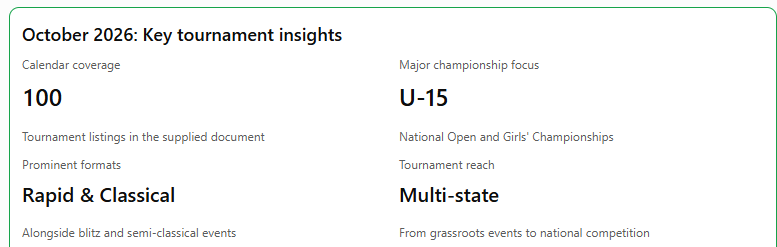
One of the major highlights of October is the 51st National Sub-Junior (Under-15) Open Chess Championship 2026 and the 42nd National Sub-Junior (Under-15) Girls Chess Championship 2026, scheduled from October 12 to 20 at Saroor Nagar Indoor Stadium, Dilshuknagar, Hyderabad.
The calendar lists 281 players for the Open Championship and 157 for the Girls’ Championship, making these two of the largest individual events featured in the document. Both are scheduled for 11 rounds, with a classical time control of 90 minutes plus a 30-second increment from move one.
These championships offer a significant competitive platform for India’s young chess players. An 11-round classical event demands more than tactical ability. Participants must demonstrate opening preparation, calculation, positional understanding, endgame technique and the stamina to maintain concentration over several days.
The championships also provide a valuable opportunity for coaches and talent scouts to observe the next generation of Indian chess.
2. Bengaluru Emerges as a Major Hub for FIDE-Rated Rapid Chess
Karnataka features prominently in the October calendar, with Bengaluru and other locations hosting competitive rapid tournaments.
The 1st Chess-Titans FIDE Rated Rapid Chess Tournament, scheduled for October 11 at VMS Grandeur Convention Hall, Dommasandra, Bengaluru, stands out with 373 players listed and a nine-round format. The event uses a 15-minute time control with a five-second increment.
Another significant competition is the 2nd Rotaract RUAS – Children Chess Academy All India Open FIDE Rated Rapid Chess Tournament, scheduled for October 18 at M. S. Ramaiah University of Applied Sciences in Bengaluru. The calendar lists 187 players and nine rounds.
The BKG Global School All India Open FIDE Rated Rapid Chess Tournament, scheduled for October 17–18 in Sandur, Karnataka, also attracts attention, with 192 players listed.
These events demonstrate the appeal of rapid chess, which offers competitive depth while allowing players to complete several rounds within a relatively short period. For developing players, rapid tournaments can help improve practical decision-making, clock management and tactical awareness.
3. Maharashtra Offers a Diverse Competitive Calendar
Maharashtra’s October calendar features a combination of rapid, blitz, semi-classical and age-group tournaments, creating opportunities for players with different competitive objectives.
The 1st Shivbhumi International Open FIDE Rapid Rating Chess Tournament 2026 in Pune, scheduled for October 17–18, is among the notable events. The calendar lists 90 players and a nine-round format, with 25 minutes per player and a 10-second increment.
Navi Mumbai will host the 16th Ramabai Ranade Rapid Chess Tournament on October 11 in Kharghar. Its Open and Under-7, Under-9, Under-11 and Under-13 categories provide a platform for players at different stages of development. The Open section has 23 players listed, while the age categories offer additional opportunities for young participants.
The Memory of Late Bhausaheb Dr. Diliprao More Inter-School Chess Competition in Nandurbar, scheduled for October 16, features Under-11 and Under-17 sections, with 108 and 118 players listed respectively.
These tournaments illustrate how Maharashtra’s chess ecosystem combines open competition with school-level participation and structured age-group development.
4. Tamil Nadu Continues to Strengthen Grassroots Chess
Tamil Nadu has a particularly varied presence in the supplied calendar, with tournaments in Chennai, Thuraiyur, Ranipet and other locations.
The GKCA & MMCA 1st International FIDE Rapid Rating Open Chess Tournament 2026, scheduled for October 11 in Pammal, Chennai, is listed as a nine-round event with a 10-minute time control and a five-second increment.
The Vijayalakshmi Memorial 1st State Level Chess Tournament 2026, scheduled for October 15, and the Adyar Times FIDE Rated Open Chess Tournament 2026, scheduled from October 17–20, add further variety to the state’s calendar. The latter is a classical tournament with an advertised time control of 90 minutes plus a 30-second increment.
Tamil Nadu also has several children’s competitions, including the Trichy District Level Children Chess Tournament and the Kundrathur State-Level Children Chess Tournament.
The breadth of events demonstrates the important role of academies, schools and local organizers in introducing young players to structured competition and helping them progress towards state and national tournaments.
5. Uttar Pradesh Hosts Large Open and Rapid Competitions
Uttar Pradesh has several notable entries, including the Shri Sanjay Agarwal Memorial FIDE Rated Rapid Chess Tournament in Bareilly, scheduled for October 17–18, with a listed prize fund of ₹10 lakh and 107 players.
The calendar also features the 1st Intelligence Rapid Chess Tournament in Muzaffarnagar on October 18, with separate Under-11, Under-13 and Under-15 categories.
The Bareilly tournament’s prize fund gives the event a significant competitive dimension, while the Muzaffarnagar age-group sections provide opportunities for young players to gain experience in a tournament environment.
Together, these events illustrate how competitive chess is reaching beyond major metropolitan centres and expanding into regional communities.
6. Madhya Pradesh Brings Rapid and Blitz Formats Together
Gwalior is scheduled to host the 11th R.K. Mishra Memorial Blitz Open Chess Tournament and the 11th R.K. Mishra Memorial Rapid Open Chess Tournament on October 11.
Both events advertise a ₹21,000 prize fund. The blitz event uses a three-minute time control with a two-second increment, while the rapid event uses 15 minutes with a three-second increment.
Hosting both formats creates an opportunity for players to test different aspects of their game. Blitz rewards rapid pattern recognition, tactical alertness and efficient clock management, while rapid allows more time for calculation and strategic planning.
The calendar also lists the Khelo Chess India 94.0 Classical FIDE Rating Tournament in Bhopal, scheduled for October 17–22, providing a longer-format competitive opportunity.
7. A Strong Emphasis on Youth and School Chess
One of the clearest trends in the October calendar is the prominence of youth and school-level events.
The SGFI Shimoga District Interschool Chess Selection in Karnataka, scheduled for October 12, features separate Under-14 and Under-17 boys’ and girls’ categories. Meanwhile, the Vetrious Chess Academy State-Level Children’s Chess Tournament in Ranipet includes multiple age groups, from Under-7 to Under-25, with separate boys’ and girls’ sections.
These competitions are important because they offer young players structured opportunities to develop tournament discipline, learn to handle pressure and build confidence against opponents of comparable age.
Regular competition also helps coaches identify strengths and weaknesses that may not become apparent during routine training sessions.
8. Rapid and Blitz Chess Are Expanding Competitive Access
Rapid and blitz formats feature prominently across the October schedule. Events in Pune, Bengaluru, Gwalior, Chennai, Kharghar and other locations provide players with opportunities to compete without committing to the longer schedules associated with classical chess.
The calendar includes a wide range of time controls, such as 10+5, 15+5, 15+3, 25+10 and 3+2.
This variety enables players to select competitions that match their experience, preparation and playing preferences. For younger players, rapid events can be a useful introduction to competitive chess, while blitz tournaments offer experienced players an opportunity to sharpen their practical instincts.
However, success in faster formats requires specific preparation. Players must develop reliable opening systems, recognize common tactical patterns and make decisions efficiently under time pressure.
9. Classical Chess Remains Essential for Long-Term Development
While rapid and blitz tournaments offer accessibility and excitement, classical chess remains an important part of the competitive calendar.
The Adyar Times FIDE Rated Open in Chennai, the 9th WMA Classical FIDE Rating Chess Tournament in Assam and the Khelo Chess India Classical event in Bhopal provide opportunities for players to develop deeper calculation, strategic planning and endgame technique.
Classical time controls allow players to explore complex positions, assess long-term plans and learn to manage their energy across extended games. For players aiming to improve their classical FIDE ratings or pursue chess titles, these tournaments can be particularly valuable.
The coexistence of classical and faster formats in October’s calendar reflects the varied needs of India’s chess community.
10. A Growing Network of Organizers Is Supporting Indian Chess
The October calendar highlights the contribution of chess academies, state associations, schools, clubs and community organizations.
From the national championships organized in Telangana to academy-led events in Tamil Nadu and Maharashtra, organizers are creating competitive opportunities at multiple levels.
The use of FIDE-rated formats, qualified arbiters, Swiss-system pairings and clearly specified time controls in many of the listed events reflects the importance of structured tournament management.
The calendar also includes memorial tournaments, school selections and community competitions, demonstrating that the growth of chess is supported by a wide network of institutions and individuals.
Featured tournaments to watch in October
Selected events from the supplied calendar
| Tournament | Date | Location |
|---|---|---|
| National Sub-Junior Open and Girls’ Championships | Oct 12–20 | Hyderabad |
| 1st Chess-Titans FIDE Rated Rapid | Oct 11 | Bengaluru |
| BKG Global School All India Open Rapid | Oct 17–18 | Sandur, Karnataka |
| 1st Shivbhumi International Open Rapid | Oct 17–18 | Pune |
| Shri Sanjay Agarwal Memorial Rapid | Oct 17–18 | Bareilly |
| Adyar Times FIDE Rated Open | Oct 17–20 | Chennai |
| 2nd Rotaract RUAS All India Open Rapid | Oct 18 | Bengaluru |
| R.K. Mishra Memorial Rapid and Blitz | Oct 11 | Gwalior |
What October’s Tournament Calendar Means for Indian Chess
The supplied listings reveal several important developments in India’s chess ecosystem.
First, competitive opportunities are becoming more geographically accessible. Players can find tournaments in major cities as well as smaller towns and districts, reducing the need to travel to traditional chess centres for every competitive experience.
Second, youth development is a major priority. National sub-junior championships, inter-school selections and academy-run age-group tournaments create a pathway from introductory competition to higher-level chess.
Third, different formats are serving different player needs. Classical events support deep strategic development, while rapid and blitz tournaments provide more frequent opportunities to compete and practise practical decision-making.
Finally, the scale of participation at selected events is notable. The 373 players listed for the Chess-Titans Rapid in Bengaluru and the 281 listed for the National Sub-Junior Open in Hyderabad illustrate the substantial interest in organized chess competition.
These figures represent the calendar’s listed entries and may change as registrations and event arrangements are updated.
ChessBox.in Perspective: Building the Next Generation of Chess Players
Every tournament is an opportunity to develop skills that extend beyond the chessboard. Preparation, patience, discipline, resilience and the ability to make decisions under pressure are valuable lessons for players of all ages.
As a leading chess set provider in India, ChessBox.in supports chess enthusiasts, schools, academies and clubs with quality chess sets, flexible chess mats, wooden magnetic sets and accessories for learning, practice and competition.
With more young players entering tournaments and more communities organizing chess events, access to reliable equipment and regular practice remains an important part of developing the next generation of Indian chess talent.
October Is a Month of Opportunity for Indian Chess
October 2026 offers a broad spectrum of competitive chess, from national-level Under-15 championships to FIDE-rated classical and rapid events, blitz competitions and grassroots school tournaments.
Hyderabad’s national championships, Bengaluru’s large rapid events, Maharashtra’s varied tournament circuit and Tamil Nadu’s extensive grassroots activity are among the key features of the supplied calendar.
For competitive players, the month offers opportunities to gain experience, test preparation and pursue rating improvement. For parents, coaches and academies, it provides a valuable schedule for planning the next steps in a young player’s chess journey.
The growth of Indian chess is not measured only by international titles and elite grandmasters. It is also reflected in the thousands of players who participate in local tournaments, the organizers who make these events possible and the young talents discovering their potential across the country.
The future of Indian chess is being shaped one tournament, one game and one move at a time.