 by
by An in-depth analysis by ChessBox.in | Global Chess Rankings | October 2026
The October 2026 FIDE Open rankings offer a fascinating insight into the changing landscape of international chess. While Magnus Carlsen continues to lead the world, a new generation of grandmasters, led by Javokhir Sindarov, Nodirbek Abdusattorov, Praggnanandhaa and Vincent Keymer, is making its presence felt at the very top.
India’s growing representation is another defining feature of the rankings, with 14 players featuring in the Top 100. From the enduring excellence of Viswanathan Anand to the rapid rise of young Indian grandmasters, the list reflects the country’s expanding depth in elite chess.
Based on the supplied October 2026 FIDE rankings document, this analysis explores the leading players, emerging talents, federation-wise representation, generational shifts and the broader trends shaping competitive chess.
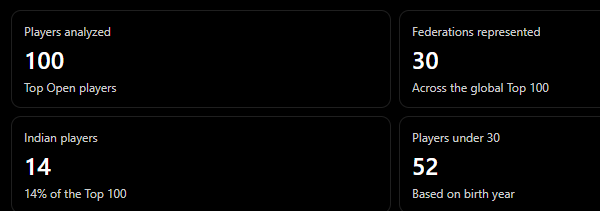
Figures calculated from the supplied rankings spreadsheet. Ages are approximate, based on 2026 minus year of birth.
1. Magnus Carlsen Continues to Set the Global Standard
World No. 1
Magnus Carlsen
Norway | Rating: 2823 | Born: 1990
Magnus Carlsen remains at the summit of the rankings, with a rating of 2823. His exceptional positional understanding, tactical awareness and endgame precision have made him one of the most influential players in modern chess.
Carlsen’s continued presence at the top demonstrates the extraordinary consistency required to maintain a world-leading rating. His ability to create winning chances from seemingly equal positions, combined with his adaptability across different formats, distinguishes his approach to the game.
The rankings also underline the significant gap between Carlsen and most of the field. However, with several players within striking distance of the 2800 mark, the battle for the top positions remains highly competitive.
2. The Top 10: A Closely Contested Elite
Top 10 players according to the supplied October 2026 list
| Rank | Player | Federation | Rating |
|---|---|---|---|
| 1 | Magnus Carlsen | NOR | 2823 |
| 2 | Hikaru Nakamura | USA | 2792 |
| 3 | Fabiano Caruana | USA | 2784 |
| 4 | Javokhir Sindarov | UZB | 2782 |
| 5 | Nodirbek Abdusattorov | UZB | 2780 |
| 6 | Wesley So | USA | 2770 |
| 7 | Praggnanandhaa R | IND | 2763 |
| 8 | Vincent Keymer | GER | 2761 |
| 9 | Wei Yi | CHN | 2758 |
| 10 | Alireza Firouzja | FRA | 2757 |
The top 10 feature a compelling mix of established champions and younger challengers. Carlsen’s lead is followed by a tightly grouped field, with only 35 rating points separating Nakamura at second place and Firouzja at tenth.
The top 10 have an average rating of 2777, based on the supplied list.
The presence of Sindarov and Abdusattorov in fourth and fifth positions is particularly notable. Both Uzbek grandmasters represent a generation that has developed in an environment of increasingly sophisticated computer-assisted preparation and intense international competition.
Praggnanandhaa’s seventh position further illustrates the continued emergence of young Indian players at the highest level.
3. India’s Growing Influence in the Global Top 100
India’s highest-ranked player
Praggnanandhaa R
World No. 7 | Rating: 2763 | Born: 2005
Praggnanandhaa leads the Indian contingent in the supplied rankings. His universal playing style, strong positional understanding and tactical resourcefulness have established him as a consistent contender in elite international events.
India has 14 players in the Top 100, making it the second-most represented federation in the supplied list, behind the United States. This is an important indicator of the depth of India’s current chess ecosystem.
Top Indian players in the October 2026 rankings
| Rank | Player | Rating | Birth year |
|---|---|---|---|
| 7 | Praggnanandhaa R | 2763 | 2005 |
| 12 | Arjun Erigaisi | 2746 | 2003 |
| 14 | Viswanathan Anand | 2739 | 1969 |
| 28 | Gukesh D | 2710 | 2006 |
| 30 | Nihal Sarin | 2709 | 2004 |
| 36 | Vidit Gujrathi | 2693 | 1994 |
| 42 | Aravindh Chithambaram | 2677 | 1999 |
| 43 | Pranav V | 2677 | 2006 |
| 44 | Pranesh M | 2674 | 2006 |
| 68 | Pentala Harikrishna | 2648 | 1986 |
| 70 | Murali Karthikeyan | 2647 | 1999 |
| 71 | Aryan Chopra | 2646 | 2001 |
| 73 | Raunak Sadhwani | 2645 | 2005 |
| 93 | Leon Luke Mendonca | 2629 | 2006 |
Source: FIDE rankings October.
The Praggnanandhaa–Arjun rivalry
Praggnanandhaa and Arjun Erigaisi are two of India’s most prominent representatives in elite chess. Their positions at seventh and twelfth, respectively, highlight the country’s ability to produce multiple players capable of competing with the world’s strongest grandmasters.
Praggnanandhaa is known for his adaptability and positional maturity, while Arjun is renowned for his ambitious, dynamic approach and willingness to take on complex positions. Their different styles add depth to India’s representation in international tournaments.
Gukesh and Nihal: The next wave of elite competition
Gukesh, the reigning World Champion in the context of the supplied rankings, is placed 28th with a rating of 2710. Nihal Sarin follows closely at 30th with 2709.
Their positions illustrate an important feature of elite chess: a player’s standing in the rating list is a snapshot of performance, not a complete measure of their potential or achievements. Both have extensive experience against elite opposition and belong to a generation that has grown up with online chess and powerful analytical engines.
Viswanathan Anand: Experience at the highest level
At 57 years old in 2026, based on his birth year, Viswanathan Anand remains 14th in the world with a rating of 2739. His position is a reminder of the value of experience, deep opening knowledge and long-term competitive resilience.
Anand’s continued presence alongside a generation of younger Indian grandmasters creates a remarkable bridge between India’s historic chess achievements and its current international strength.
4. The United States Leads Federation Representation
The United States has 16 players in the Top 100, the largest representation of any federation in the supplied document. India follows with 14, while China and Russia each have seven. Uzbekistan and Azerbaijan have five players each.
Federations with the most players in the Top 10005101520USAIndiaChinaRussiaUzbekistanAzerbaijanUkraineArmeniaNorwayGermany
The United States benefits from a diverse group of established and emerging grandmasters, including Nakamura, Caruana, Wesley So, Leinier Dominguez, Levon Aronian and several younger players.
India’s 14 representatives demonstrate substantial depth across different generations. China and Russia also retain a strong presence, while Uzbekistan’s five players reflect its increasing visibility in the international elite.
These figures represent player counts, not a measure of overall federation strength. They nevertheless offer a useful view of how widely elite chess talent is distributed.
5. Uzbekistan’s Rise Is One of the Defining Stories
World No. 4
Javokhir Sindarov
Uzbekistan | Rating: 2782 | Born: 2005
Sindarov’s fourth-place position places him among the world’s leading players. His dynamic style, tactical alertness and ability to handle complicated positions make him a significant presence in elite competition.
Uzbekistan has five players in the Top 100, including Sindarov, Abdusattorov, Nodirbek Yakubboev, Rustam Kasimdzhanov and Shamsiddin Vokhidov.
Sindarov and Abdusattorov, ranked fourth and fifth, are particularly striking examples of the country’s young talent. Both were born in the 2000s and have established themselves among the world’s highest-rated players.
Their achievements also demonstrate how a strong youth development environment, competitive opportunities and sustained exposure to international events can contribute to the emergence of elite players.
Uzbekistan’s representation is not limited to its two highest-ranked stars. The presence of several other grandmasters in the Top 100 reflects a broader competitive base.
6. A New Generation Is Reshaping Elite Chess
One of the most revealing insights from the rankings is the number of young players competing at the highest level. According to the birth years in the supplied document, 28 players in the Top 100 are under 25, while 52 are under 30 in 2026.
Several young grandmasters stand out:
Yagiz Kaan Erdogmus
Rank 17 | Rating 2731 | Born 2011
One of the youngest players in the Top 100, Erdogmus is a remarkable example of the speed at which young players can progress in contemporary chess. His ranking places him among the world’s elite while still in his teenage years.
Abhimanyu Mishra
Rank 85 | Rating 2636 | Born 2009
Mishra made chess history by becoming the youngest grandmaster in 2021. His appearance in the Top 100 reflects his continued development and his ability to compete at a high level.
Ediz Gurel
Rank 74 | Rating 2642 | Born 2008
Gurel is another member of the new generation whose presence in the Top 100 demonstrates the growing international reach of young chess talent.
Leon Luke Mendonca
Rank 93 | Rating 2629 | Born 2006
Mendonca represents India’s emerging grandmaster generation, adding further depth to the country’s presence in the global rankings.
The success of these players highlights the increasingly early age at which grandmasters are reaching world-class strength. Access to online tournaments, chess databases, engine-assisted analysis and international coaching has transformed the modern development pathway.
7. Experience and Longevity Remain Important
While young grandmasters are reshaping the rankings, several experienced players continue to occupy prominent positions.
| Player | Rank | Rating | Birth year |
|---|---|---|---|
| Viswanathan Anand | 14 | 2739 | 1969 |
| Veselin Topalov | 34 | 2695 | 1975 |
| Peter Leko | 51 | 2663 | 1979 |
| Boris Gelfand | 76 | 2641 | 1968 |
| Vasyl Ivanchuk | 94 | 2628 | 1969 |
| Loek van Wely | 98 | 2627 | 1972 |
These players have experienced different eras of chess, from the dominance of classical opening preparation to the modern age of powerful engines and computer-assisted analysis.
Their continued presence in the Top 100 demonstrates the importance of accumulated knowledge, positional understanding and the ability to adapt to changing competitive conditions.
The contrast between young players such as Erdogmus and experienced grandmasters such as Anand and Ivanchuk makes the rankings particularly interesting. They show how different playing generations continue to coexist at the highest level.
8. The Rating Gap: A Highly Competitive Top 100
The difference between first and tenth place in the supplied list is 66 rating points, while the difference between first and 100th place is 197 points. The average rating of the Top 100 is approximately 2680.
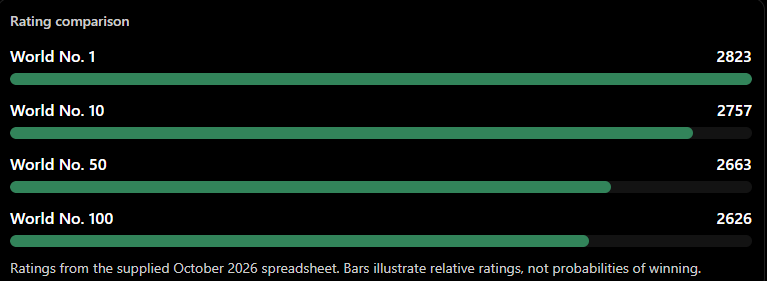
The relatively narrow rating gap among the top players highlights how closely matched many elite grandmasters are. At this level, preparation, form, tournament conditions and the ability to handle critical positions can all have a significant influence on individual results.
The ratings also demonstrate the extraordinary standard required to enter the Top 100. Even the player ranked 100th in the supplied list has a rating of 2626, a level that reflects years of high-level competitive experience.
9. China, Russia and Azerbaijan Maintain Strong Representation
Beyond India, the United States and Uzbekistan, several established chess nations continue to feature prominently.
China has seven players in the Top 100, including Wei Yi, Ding Liren, Yu Yangyi, Wang Hao and Bu Xiangzhi. Wei Yi, ranked ninth with a rating of 2758, leads the Chinese contingent in the supplied list.
Russia also has seven players, including Ian Nepomniachtchi, Daniil Dubov, Vladislav Artemiev and Alexander Grischuk. Their presence illustrates the country’s continuing depth of grandmaster talent.
Azerbaijan has five players in the Top 100, including Shakhriyar Mamedyarov, Teimour Radjabov and Aydin Suleymanli. Their representation reflects the country’s established chess tradition and continuing contribution to elite competition.
The overall list includes 30 federations, extending from major chess nations to countries with one representative. This geographical spread reinforces chess’s international character and the growing number of countries producing grandmasters capable of reaching the highest level.
10. The Battle for the Future of Elite Chess
The October rankings reveal several important themes that could shape international chess in the coming years.
First, the established elite continues to maintain a high standard. Carlsen, Nakamura and Caruana remain near the top, while Anand and other experienced grandmasters continue to compete against much younger opposition.
Second, the next generation is already firmly established. Sindarov, Abdusattorov, Praggnanandhaa, Keymer and Firouzja are no longer simply emerging prospects; they are among the highest-rated players in the world.
Third, India’s presence is increasingly broad-based. With 14 players in the Top 100, the country has representatives across multiple age groups and playing styles. This depth creates a strong foundation for its continued participation in elite individual and team competitions.
Finally, the appearance of very young players such as Erdogmus demonstrates how quickly the international chess landscape can evolve. The next generation is already competing with established champions, making future tournaments particularly compelling for chess enthusiasts.
India’s Top 100 Presence: A Closer Look
India’s representation
14 players
Across the Top 100, including 3 players in the Top 15.
Players ranked inside the Top 50
Praggnanandhaa, Arjun Erigaisi, Viswanathan Anand, Gukesh, Nihal Sarin, Vidit Gujrathi, Aravindh Chithambaram, Pranav V and Pranesh M.
Players ranked from 51 to 100
Pentala Harikrishna, Murali Karthikeyan, Aryan Chopra, Raunak Sadhwani and Leon Luke Mendonca.Based on the supplied rankings. Nine Indian players appear in the Top 50, not including any player outside the listed positions.
Conclusion: A New Era of Global Chess
The October 2026 FIDE Open rankings present a picture of a sport evolving across generations and continents. Magnus Carlsen continues to lead, but the presence of several young grandmasters near the summit demonstrates that the competitive landscape is constantly changing.
India’s 14 players in the Top 100, Uzbekistan’s growing elite representation and the continued strength of the United States, China and Russia all point to a broad and highly competitive international chess environment.
For chess enthusiasts, these rankings are more than a monthly record of ratings. They provide a way to follow the development of future champions, appreciate the achievements of established legends and understand the changing balance of international chess.
At ChessBox.in, a leading chess set provider in India, we celebrate the players, ideas and achievements that inspire the next generation. Whether you are an aspiring grandmaster, a tournament competitor, a student or a recreational player, the journey of these elite chess professionals is a reminder of the value of consistent practice, strategic thinking and a lifelong passion for the game.
The world of chess is changing, and the next chapter is already being played on the 64 squares.